I've never been sure about this thing, Facebook, but recently took a tentative step into it. On my personal page friends rapidly accumulated and chit chat flowed. So there's now a page for Englemed on Facebook. It brings together some of our material - mainly that of interest to the youngish group who use Facebook - so the emphasis will be on family health news.
We'll also add occasional links to other articles of interest. For instance Andrew Wadge of the UK Food Standards Agency runs an impressive blog - which we link to from here.
You find it simply by searching for "Englemed" within Facebook. If you're a Facebook regular it's an easy way to check out some of our material - stories will simply appear on your "wall" if you sign on as a fan.
Thursday, April 16, 2009

Wednesday, April 1, 2009
April Fools?
So far no sign of a good medical April Fool today. Perhaps everyone has learnt their lessons.
Reading the daily welter of health and medical headlines, you can of course never be sure.
Doctors may be feeling their pay rise announcement is a joke - but strictly speaking that was announced yesterday. Both our lead stories - an allergenic substance in shampoo and a new treatment for MRSA - were announced yesterday so they also are safe.
There's a welter of announcements from the UK Department of Health to mark the new financial year. I think they are meant to be serious although most wise people are avoiding making announcements today.
The BMJ has published a deadly serious story today - no chance of it being a spoof - and I happen to know that the lead author Chris Ham is a real person.
Aah, now here's a possible spoof on the Beeb: donkey milk and nine other ways to live to 100. The tips include fried egg and sausage sandwich. They've covered themselves by quoting from apparently real centenarians - so no evidence that these diets will help the ordinary Joe Bloggs.
Monday, March 16, 2009
Lifestyle the key - it's a secret!
There's new evidence this week that European medicine is failing to tackle unhealthy lifestyles. Back in September we had a big grumble about the state of British medicine.
Now European researchers have concluded that just one third of high risk patients are referred to lifestyle programmes - by that they mean people with high blood pressure, high cholesterol and too much weight.
Instead doctors and health systems rely on treating patients by drugs, according to the EuroAspire report. This was my comment back in September.
It is in fact the same team whose work formed the basis of my September posting and at the time they did not mention the over-reliance on drugs. But they could already see evidence that European medicine, including Britain, has not taken on board the evidence about lifestyle collected by the Americans.
I still think they are right. British primary care is now finely organised to find high risk patients and this is likely to get better. But the answer, when a problem is found, is usually pills. To be fair, not always. Where I live they are now giving people free passes for the gym and swimming - but not much dietary advice. And the free passes are being snapped up by the worried well.
Are Professor David Wood and his team wrong? What do you think?
Thursday, February 5, 2009
Another embargo break
Where now for embargoes? Today sees another major break in the dam. The culprit so far as my monitoring can tell is The Times - that is the Times of London, for non-UK readers.
Another indication that something is afood is that The Times has gone to a lot of trouble to break a non-story. Their headline today - published at 11.11pm GMT on the web, is "Vitamin D is ray of sunshine for multiple sclerosis patients". This is not new and the latest research, which was due to be published at 10pm GMT on Thursday seems to be merely a scientific study explaining why this seems to be the case. Vitamin D generally requires sunshine and those of us who live in the northern half of the northern hemisphere do not get as much exposure as others.
A sad memo arrives from the publisher PLos Genetics: "Dear Colleagues, Please note that the embargo on this article has now been lifted due to an embargo break. We apologize for any inconvenience.
*****************************************************************************************************************
* * * * * EMBARGO: Thursday, 5th February 2009 * * * * * *
2PM PDT/ 5PM ET/ 10PM GMT ."
Please don't apologise. It's not your fault! As the release had been posted in the embargoed section of Eurekalert! you have to wonder what the fall out will be.
Wednesday, February 4, 2009
Dog eats dog over embargo row
Last year we predicted that embargo policies were going to come under increasing pressure because of on-line news (Englemed respects embargoes but with difficulty) and also because of the difficulty of observing US Time zones.
Yes, that's what has happened - and an almighty transatlantic row has broken out. The American Association for the Advancement of Science is affronted at European and British, in particular, attitudes and has been busy suspending or removing local outlets from access to its well-established Eurekalert! database. I'm told that organisations as diverse as The Telegraph, Die Welt and Ansa News have been suspended. The biggest row seems to be over the removal of the tabloid Sun newspaper from Eurekalert! over a science story Life on Mars.The Sun was later reinstated as a freelance had supplied the story.
Now the Association of British Science Writers is apparently to conduct a review of embargo policies. The UK Press Gazette has the story and the ABSW blog has some insights into the whole saga. More on this later maybe.
Meanwhile here's another embargo breach today, this time by the venerable old BBC. Wonder whether they will have their access suspended? You have to look at the times and dates - there is a 90 minute discrepancy.

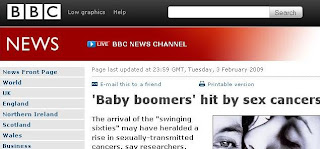
Yes, that's what has happened - and an almighty transatlantic row has broken out. The American Association for the Advancement of Science is affronted at European and British, in particular, attitudes and has been busy suspending or removing local outlets from access to its well-established Eurekalert! database. I'm told that organisations as diverse as The Telegraph, Die Welt and Ansa News have been suspended. The biggest row seems to be over the removal of the tabloid Sun newspaper from Eurekalert! over a science story Life on Mars.The Sun was later reinstated as a freelance had supplied the story.
Now the Association of British Science Writers is apparently to conduct a review of embargo policies. The UK Press Gazette has the story and the ABSW blog has some insights into the whole saga. More on this later maybe.
Meanwhile here's another embargo breach today, this time by the venerable old BBC. Wonder whether they will have their access suspended? You have to look at the times and dates - there is a 90 minute discrepancy.


Thursday, January 29, 2009
Christmas confusion lasts for decades
A curious example of the kind of confusion caused by those light-hearted Christmas medical journals cropped up this week.
The British Medical Journal printed a letter in which a doctor admitted making up a condition some 30 years ago. The condition, dubbed Cello Scrotum, was supposed to be an injury acquired by cellists. It was a fiction, a prank.
Nevertheless there it was in a respected medical journal. So in December it was recycled in a further light-hearted article in the BMJ about musical maladies. It must be hard enough being a cellist without having to worry about damage to your manhood.
So at last the authoress of the original letter owned up. By now she has risen to great heights and is Baroness Elaine Murphy, a member of the British House of Lords.
The Baroness owned up but in an unrepentant kind of fashion. She stated: "We have been dining out on this story ever since. We were thrilled once more to be quoted in 'A symphony of maladies.'"
Thursday, January 22, 2009
Trusting the media?
A fascinating study from Japan today where researchers argue that the mass media actually improves health.
The press release was headed "Trust me, I'm a journalist." The implication is that where people have faith in their mass media, they tend to absorb healthy living messages and improve their health.
The findings come from a major survey of 29 Asian countries involving tens of thousands of people, so they should not be sneezed at. In fact you would expect me to agree with them. After all the whole point of a health news service is to ensure everyone is better informed - and that readers and users learn to make sensible judgements about what's good and bad for you.
However there's a question of cause and effect here. Do the people of the Maldives trust the media because it is trustworthy - or because they are a little naive? And what makes the people of Hong Kong cynical? Their history?
So what's not clear from this study is whether it is the quality of the local media that makes a difference. Or whether it is the willingness of the public to take in the messages disseminated by mass media of all kinds that improves health. After all in Britain the experience is that the "mass media" can do enormous harm as well as good. Measles is currently on the rampage because of a false scare about the MMR vaccine.
You would have thought that a certain amount of informed scepticism would be the right way to treat media messages. Certainly not outright cynicism. Intelligent readership will recognise that every breakthrough, every scare, every bit of new advice may be wrong - but it also may be right. Without the mass media, people might not recognise the dangers of obesity, of poor diet and of smoking. It's no coincidence that the Asian researchers also linked health to educational levels.
Recognising that no single report can be taken in isolation, we try to present a complete news service here.
Tuesday, December 30, 2008
Merry Christmas?
No I didn't forget it was last week. I wanted to point out there is a tradition of jollity in the world of medical news that is in danger of being fractured by the advent of e-publishing.
The way it worked was this. The press releases for each week's British Medical Journal and Lancet would be issued, embargoed, for publication every Friday. It meant that both eminent journals released their Christmas issues the Friday before Christmas - and the Christmas issue was traditionally pretty wacky.
Over the last year the embargoed Friday press releases have all but ceased. Articles are published on the internet first. Embargoes are enforced but they can be any day of the week.
This year's Christmas British Medical Journal stories were released on Thursday 18th and they were certainly a crazy mixture. We headed the story Head-bangers, texting, Twist and Slam.There was a second one about common medical myths. It is true that some of the reports contain a germ of seriousness - but it was interesting that so far ahead of Christmas a number of reporters seemed to report some of these items with po-faced seriousness.
And of course the Lancet did not come out the same day. In fact it does not seem to have had a comparable collection of stories - although a series of reports trickled out. There was the one about the woman who fainted after eating sandwiches. And another one about sneezing emerged so late that we did not bother to report it.
Saturday, November 29, 2008
A dose of our own medicine
A report this week struck right at the heart of what we do. Yes. it was another analysis of the world's medical journalism.
There was a conflict of interest but we did not hold back. We reported the story.
Like most such analyses, it concluded that most medical journalism in the mainstream media is flawed. That's no surprise. But the study, from Alberta, Canada, did make some interesting points.
It suggests four kinds of basic information that should be included:
Tania Bubela, who conducted the research, seemed to want to make the case that reporting is biased against alternative therapy. So I think that was why dose was important in her mind - as it is less standard in, say, herbal medicine than in mainstream.
Methods is an interesting challenge. Yes we always try and report the methods used. Frankly its tedious for the writer and the reader. The problem is that the "gold standard" is the randomised control trial. This means that neither the doctor nor the patient knows whether they are receiving the real pill or a fake - known as a placebo. As we saw in the case of acupuncture, creating a placebo can be problematic. It's okay with pills but with other therapies, how do you fake them?
There are other statistical methods, mainly involving the analysis of populations. These will tend to tell you about the impact of diet and lifestyle. They are rarely conclusive on their own but taken together, over the years, they can be pretty convincing. It was that kind of analysis that proved that smoking causes lung cancer - it took a long time.
And that's where numbers come into it. Yes, we would always report the number of people in a trial. It's very important. If percentage differences between a treatment working and not working are close, you want to see large numbers - thousands. If they are overwhelming smaller numbers, say hundreds, will do. The trouble is we still live in a world where some people have done statistics (and hence standard deviation etc) at school and others have not. Increasingly the younger generation, certainly in Britain, will have at least a smattering of statistics.
Finally there's conficts of interest. I touched on this in a recent posting. Frankly it's not always easy to know. But yes there are some stories which are disseminated actively by commercial interests. We are more cautious of these than others, perhaps. And we see sourcing as important. If we report a therapy, the report will generally come from a journal or a conference, possibly via a university. We will identify that source in detail. That's not usual in the mainstream media.
There was a conflict of interest but we did not hold back. We reported the story.
Like most such analyses, it concluded that most medical journalism in the mainstream media is flawed. That's no surprise. But the study, from Alberta, Canada, did make some interesting points.
It suggests four kinds of basic information that should be included:
- the number of patients;
- the methods used;
- the doseage;
- conflicts of interest.
Tania Bubela, who conducted the research, seemed to want to make the case that reporting is biased against alternative therapy. So I think that was why dose was important in her mind - as it is less standard in, say, herbal medicine than in mainstream.
Methods is an interesting challenge. Yes we always try and report the methods used. Frankly its tedious for the writer and the reader. The problem is that the "gold standard" is the randomised control trial. This means that neither the doctor nor the patient knows whether they are receiving the real pill or a fake - known as a placebo. As we saw in the case of acupuncture, creating a placebo can be problematic. It's okay with pills but with other therapies, how do you fake them?
There are other statistical methods, mainly involving the analysis of populations. These will tend to tell you about the impact of diet and lifestyle. They are rarely conclusive on their own but taken together, over the years, they can be pretty convincing. It was that kind of analysis that proved that smoking causes lung cancer - it took a long time.
And that's where numbers come into it. Yes, we would always report the number of people in a trial. It's very important. If percentage differences between a treatment working and not working are close, you want to see large numbers - thousands. If they are overwhelming smaller numbers, say hundreds, will do. The trouble is we still live in a world where some people have done statistics (and hence standard deviation etc) at school and others have not. Increasingly the younger generation, certainly in Britain, will have at least a smattering of statistics.
Finally there's conficts of interest. I touched on this in a recent posting. Frankly it's not always easy to know. But yes there are some stories which are disseminated actively by commercial interests. We are more cautious of these than others, perhaps. And we see sourcing as important. If we report a therapy, the report will generally come from a journal or a conference, possibly via a university. We will identify that source in detail. That's not usual in the mainstream media.
Saturday, November 15, 2008
Is acupuncture harmful?
There's a curious story we've written which may appear on this site quite soon. It is about acupuncture and reports a Chinese study of the impact of acupuncture on fertility treatment.
The researchers in Hong Kong set out to be scientific in their research and used standard medical research techniques. And that causes the problem.
The research compared fake acupuncture with real acupuncture. In fake acupuncture, treatment is given with fake needles which retract when pressed against the skin. This was meant to be the same as the use of a placebo in drugs trial. A placebo is a dummy pill meant to make the patient think they might be receiving treatment. So the psychological impact of receiving treatment is taken into account.
So if a drug works, patients taking the real drug fare better than those taking the placebo. If a drug is harmful, patients fare worse on the real thing. And if a drug is totally ineffective, both placebo and drug are about the same.
What Dr Ernest Ng and his colleagues concluded was that women who received fake acupuncture were more likely to get pregnant than those receiving the real thing. The women were received IVF treatment and 55 per cent of those in the first group were successful - compared with 45 per cent of those getting fake acupuncture.
What can be concluded from this? Almost certainly that acupuncture for fertility treatment does not work. But does fake acupuncture work? And is real acupuncture actually harmful, as you might conclude?
And how on earth do you write the story?
It would be a great deal easier if acupuncture had been compared with nothing. You could then conclude that acupuncture wasm harmful. But it is also possible that fake treatment is beneficial. It involved applying gentle pressure to acupuncture points - and maybe that is better than inserting a needle when a woman is trying to get pregnant.
It's been said that journalism is the first draft of history. Our story reads:
Pretend acupuncture may help boost fertility - and is better than the real thing, according to new findings.
That was not our first draft and it is just about tenable. The researchers certainly believed that the placebo effect was genuine - that fake treatment had helped to stimulate the women in some way.
It's also possible that real acupuncture was harmful to these women.
And it is even possible the whole thing is a statistical freak. The research involved just 370 women - and that is not a great deal when you are seeking a statistically robust result.
Monday, November 10, 2008
An advertising policy
If you go to our page on services and policies, you will find our policy on accepting advertising is "currently under review". It's said that for ten years - as that has been the case for ten years. The Englemed site became largely a showcase for potential clients and we drifted away from our original idea of providing a news site for the public.
Now that's changed following a major revamp. And, after some consideration and research, we even have an advertising policy - which you can see reflected on the site!
We hope the site is now more useable and that it contains useful information.
The problem we had with advertising was not to compromise the independence of our news service. We are almost unique in that we do not draw from the main news agency sources that feed all media, papers, TV and web - mainly Reuters and the Press Association. You can see that today in our very different take on the story about statins and heart disease.
If we provide a service to another website there's a good chance they may be taking pharmaceutical sponsorship or relying on selling health products. When we agree a contract we negotiate carefully so they can reassure their users the news service is unbiassed. When there's been pharmaceutical sponsorship our experience has varied - but at the very least it tends to mean some restriction on what is published. One approach is simply to agree not to report about any marketed drugs. It means the news is about other issues, lifestyle, causes etc. That's fine - but we get unhappy if we come under constant pressure to identify, say, a particular cause when there may not be medical consensus about it.
On this site we think you need to be sure we won't hold back from reporting good or bad news about a treatment. So we don't want to be reliant on pharmaceutical sponsorship - even if it were possible (and there are legal issues involved too). Nor do we want to promote herbal remedies, vitamins, dietary supplements or alternative therapies. The news about these treatments tends to be mixed and you need to be sure you are getting it fairly. They may crop up on google ads which appear on blogs. That's fine - their appearance is largely out of our control although we can and will block a repeat advertiser who is clearly disreputable.
We have for some time promoted a limited range of books from reputable organisations and authors. And thanks to the wonders of affiliate schemes, we can now promote other relevant material to our visitors. We've always had a strong family focus. This is a feature we did on pregnancy issues some time ago. And our redesign gives fresh emphasis to this.
So if you're having a baby, there's maternity wear. There's toddler and baby safety devices. And there are those hard to find gifts for all the family and special occasions. There's even a garden centre! We think this is the right kind of ethical advertising for this site - so readers can be assured they are getting real news!
Tuesday, October 21, 2008
In praise of newspapers
I worked on newspapers for nearly two decades before seeing the potential of the internet and becoming one of the first full-time on-line journalists.
It's ironic that in Britain the BBC should have become the main on-line news player. We can't pretend they are not - they dominate. For it is newspaper values, not broadcasting values that dominate web-publishing.

Consider what newspapers did:
They offered readers an instant selection of news, a kind of visual menu. It's not just the cramming of stories onto pages, it is the use of headlines. Over decades sub-editors perfected the art of writing short, snappy, intriguing headlines that caught the reader's eye and led them to that particular article. The art of the sub was refined by the constraints of the page. The sub was only allowed so many letters per headline - and often not many.
Newswriting was the same. The first sentence, the intro, has to sum up the whole story. It also has to be snappy and interesting. In a tabloid, it's more snappy, in a broadsheet it contains more detail. But the reader has to be able to take it in at a glance.
The same techniques are applied to the whole story.
Then the newspaper as a whole and each page is laid out with the same intent. The main headline, the big one in large print, is designed to be spotted by the casual browser passing by a newsagent or a newstand.
It's just the same as the web. Your readers are passing by. You have to catch their attention with a headline, with an intro. You have a fraction of a second to do so. The headline must be different and interesting. The first few words of the story must tell them it's interesting.
These are techniques and crafts that were built up over a century. If you worked on newspapers they were hammered into you.
That's why we prize newspaper experience at Englemed. We like good writing and good headlines. I always believed that newspapers, not the TV or radio, provided the template for the web. I was never sure they would adapt well - and the jury is still out on that. Many are struggling. Yet while the BBC, backed by licence fee cash, may dominate, it's had to learn newspaper ways and probably recruit newspaper journalists.
Monday, October 6, 2008
Englemed writer wins award
Congratulations to our Australian correspondent Leigh Parry who has won a major award in her home country for her writing.
Leigh's work in medical journalism came to the attention of the judges through her feature articles in a local magazine, the Medical Observer.
Here are the full details of her success:
Awards recognise outstanding contribution to medical journalism
Leigh Parry and Helen Signy recognised with RACGP Media Awards
2 OCTOBER 2008 - The Royal Australian College of General Practitioner (RACGP) is presenting two awards tonight recognising contributions to Australian medical journalism.
Dr Vasantha Preetham, outgoing RACGP President, will be presenting the awards tonight at the Academic Session of the Wonca Asia Pacific Regional Conference/RACGP Annual Scientific Convention 2008 in Melbourne.
The awards recognise the excellent work of medical journalists in the areas of general practice news journalism and general practice clinical journalism.
“The media plays an important role in communicating key health care messages to the public. This means that journalists have a critical role in ensuring their reports are accurate, balanced and responsible,” said Dr Preetham.
“The RACGP is a champion of quality and excellence in general practice, so it is no surprise that we have extended this to health journalism! Congratulations to Leigh and Helen,” said Dr Preetham.
The winners for 2008 are:
RACGP Award for General Practice Clinical Journalism
2008 Winner: Leigh Parry (Medical Observer)
This award recognises the medical journalist whose work displays the specialist skills required for accurate reporting of clinical medical issues and whose work has had a significant impact on Australian general practice over the past year. The winner’s work has been judged as having consistently met high standards through appropriate research, balanced reporting and demonstrating respect for their audience, and whose work has supported high standards of general practice care for the people of Australia. In particular, Leigh is being recognised for her Medical Observer feature stories, which are balanced and well researched.
Monday, September 29, 2008
Drugs or lifestyle - which is Britain serious about?
I find the comments made for World Heart Day yesterday quite disturbing. The European Society of Cardiology is concerned that health services are failing to take simple steps to reduce the risk of heart disease.
In other words, across Europe doctors and community nurses are failing to give basic but firm advice to patients - that they are too heavy, they should not smoke and they should improve their diet and take more exercise.
"The vast majority of high risk patients in Europe are not provided with a professional lifestyle and risk factor management programme," according to Professor David Wood.
It will be interesting to see how British doctors react to the statements. for there has been an increase emphasis in modern general practice, backed by contractual incentives, on preventing disease. If you smoke, you will certainly be encouraged to give up. If you visit your doctor, you are likely to have your blood pressure taken.
But then what?
As someone with relatives with high blood pressure I perceive a problem. For the Americans several years ago established that good diet and low salt levels can be almost as effective as drugs as reducing blood pressure. This was a massive study called DASH.
So should not every patient with high blood pressure be referred to a dietician? In my experience this does not happen. And just in case, I checked the latest guidelines from the National Institute for Health and Clinical Excellence. It turns out they are purely "pharmacological". All about drugs. There is no requirement to do anything about diet - so little gets done. Here's the link.
You won't get the same official guidance in the USA. There the National Heart Lung and Blood actively promotes the DASH diet. Here's the link. It even includes recipes.
You can sense the frustration in the European Society of Cardiology. They have done similar studies and yet governments are not rushing to take up their guidelines. In Britain it is the same government that complains frequently and bitterly about the rising cost of prescriptions. Why?
It also tells people to lose weight and urges "five a day". Yet the system fails to link this well-meaning advice directly to the diseases that people suffer and the drugs they are required to take. Is this a result of our paternalistic health system or just a conspiracy? Is it just a shortage of dieticians? Or am I wrong?!!
Here's the link to the latest Euro-heart guidelines, which set out not just what patients should do but what professionals should do.
Subscribe to:
Posts (Atom)